
First Spring
Notes from Minneapolis

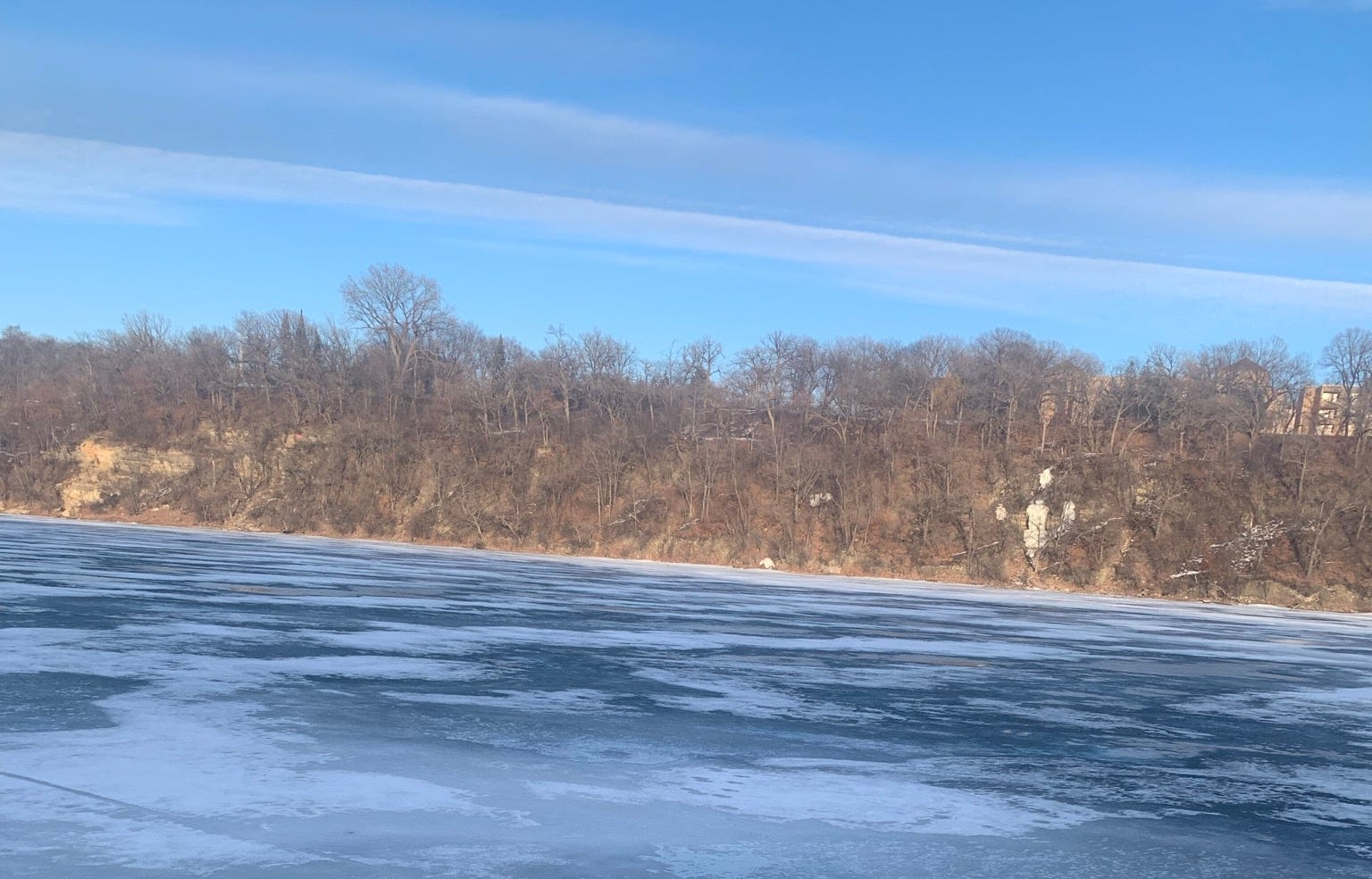
The other day I went to the river and asked her to take away my stomachache. It came on the heels of weeks spent not tending very graciously to my body’s needs, or even really acknowledging that I have a body (and if you recognize this to be a predictable part of my cycle, just know that I am working on it). The pain was persistent and uncomfortable but not debilitating—I’d considered asking the river for some greater healing, but I didn’t want to ask for too much. My friends and I walked out on the frozen water and lay down on our backs as my abdomen clenched and released, clenched and released. It was the first outing I’d made with these friends in a month, since we’d walked out on a different body of frozen water in ICE-occupied Minneapolis and screamed, and screamed.
Hours later, a different friend hugged me then asked why I was so wet, and I realized that the ice had soaked through my coat and into my hoodie. I hadn’t noticed. It was just beginning to warm up that day, the frozen everything just starting to thaw. Approaching the riverbank, we’d noticed a sweaty quality to the ice, but it seemed safe enough—in any case, it held us. On the drive back, we saw a host of ambulances on the other side of the river, and the next day we learned they were there because someone had fallen through the ice and drowned. We made it home safely, and that other person didn’t, through no fault or virtue of any of ours.
Through no fault or virtue of mine, I have a legal right to exist in this country, while other people—who have endured so much more to be here—don’t. This fact maybe more than any other has given rise to my life and its contours, to the pleasures and privileges I’ve been allowed to exercise. I could go to college, I could study in England for a year in college, I could graduate college and find work as a teacher then a care worker then an adjunct professor, meaningful but also comfortable work that keeps my hands soft and demands very few sacrifices. I can travel freely, I can move around, I can make plans to study in Italy for a semester, just to write, then just as easily cancel those plans to stay in Minnesota when the conditions of my heart shift.
And the conditions of my heart have shifted. I imagine that yours have, too.
Since December, life in Minneapolis has remade itself so thoroughly and in so many distinct ways that I find it difficult to account for even a part of it. We’ve been living in an era of A.T.C. (All Things Considered), in which plans can only be made in B.D. (Barring Disaster) time. How are you? Oh, A.T.C., I’m doing okay. I’ll see you at the meeting tonight, B.D. Our days proceed according to rhythms grounded in new and increasingly abolitionist ways of relating to ourselves and our neighbors. I’ve often felt like we’ve been living in a pocket universe, cut off from the rest of the world as we’ve dived down more and more hyper-locally. It’s been difficult for me to communicate with any regularity, much less normalcy, with people who aren’t here. They haven’t witnessed vulnerable people be snatched off the side of the road. They don’t jump at the sound of every car horn, every whistle-like noise from the radiator or the fridge. They don’t understand my acronyms.
I can’t remember major swathes of the occupation timeline. What have I been doing all this time, and with whom? I have this nagging feeling that I’m going to be asked to explain myself, and soon, and that I won’t know what to say. My journal’s no help with this—I’m an avid journaler by nature, but there’s a gap in my entries between January 4th, three days before ICE killed Renée Good, and January 25th, one day after ICE killed Alex Pretti. I was working dispatch shifts during both of their deaths, which means I was communicating through Signal calls with people watching over their neighborhoods, trying to help keep everybody connected and safe.
We have definitely kept connected (intrinsically, intimately), but whether or not we’ve kept each other “safe” is a different and much more complicated story. As with the question of whether or not the people are “winning” in the struggle to resist (and abolish) ICE, it depends who you ask, and when. What does “safety” mean when thousands of our neighbors have been kidnapped, and two have been killed? What does “safety” even feel like in such a stark reality? To me, it feels like driving around town and seeing dozens, sometimes hundreds, of people standing on street corners with whistles around their necks, keeping watch and waving at me when they see a whistle around my neck, too. It also feels like being piled on a sofa or a bed with one or two or ten friends who I love so fiercely I cannot begin to get into it here. But I’ve also spent most of the past two months experiencing low-grade panic symptoms that sometimes boil over unignorably, like when I had an anxiety attack during the second act of a play I attended in January to try to feel normal. Most mornings I’ve woken up long before my alarm with my heart beating so fast and hard that I give up on sleep, get out of bed, and start looking for a way to be useful. I’m documenting this not because I think my experience is unique but to help record how fascism acts on all of our bodies, even those of us relatively buffered from the worst of it.
The heartbeat thing happened again this morning, despite the fact that there’s been a dramatic reduction in ICE activity the whole past week. This might be because the surge is actually, finally, coming to an end soon, although abductions are still happening, and ICE is still here. We are all very restless about the newfound quiet, which hasn’t proven itself trustworthy. We’re also all restless about what the end of the surge will mean for everybody as we exit emergency-response mode and attune to all this wreckage. Life here will have to remake itself, yet again, in the wake of so much suffering—and I know that my own low-grade panic amounts to very little compared to the totalizing grief, pain, isolation, and instability experienced by Minnesota’s immigrant communities, who are still missing so many of their people. For those of us trying to act in solidarity with them, there is so much work to do. We’ve responded to this crisis, but far from perfectly; how will we act when the crises no longer feel as imminent, as visible? I’ve been astonished by the bravery and commitment of the beautiful collective body that is Minneapolis, but I nonetheless worry that we—and here I mean white organizers and neighbors, specifically—aren’t up to the many tasks laid before us like planks in a necessary but precarious bridge. Not yet, at least. We are years and years, generations, behind, and we have to catch up.
It’s only gotten warmer in the days since I went to the river, leading many around me to accuse the climate of producing a “false spring.” I don’t like this way of describing it, because what exactly is false about all this sunshine, this melting snow? Doesn’t that hold our battle-weary climate to a standard of predictable progress that no other element of the natural world—least of all us—can live up to?
I am trying to trust this little spring, not because I think it will last but because I think it can teach us something. Winters don’t last forever, nor do sieges, nor do empires. I am trying to think of this reprieve from the cold as the first spring of multiple before May Day, glorious May Day, is upon us, and we can skip work and make puppets and kiss all the neighbors whose names we never knew before this occupation but who are damn good at identifying vehicle types, or grocery shopping in bulk, or knowing cardinal directions. I am not good at any of those things, although I’m better than I once was. I hope some of my neighbors want to kiss me, anyway. Much more than that, I hope the Minneapolis streets and parks and puppet parades are flooded with people who’ve been sheltering in place for so long, far too long, but finally feel safe enough to breathe outside air. I hope that air tastes like freedom, and that they can share it with their once-missing loved ones, who are back by their sides.
As I publish this, it is snowing again.
P.S. Even after the surge ends, the people of Minnesota will need support for a long time. If you can, I recommend donating to any of the fundraisers listed at www.standwithminnesota.com, or you can reach out to me for more specific suggestions. You can also reach out to me if you’re interested in next week’s “Melt the ICE” Week of Action in the Twin Cities, which many brilliant people here are hard at work organizing.
Thanks for sharing. There is beauty and pain in simply bearing witness, and you are doing so much more than that.
<3 one of the most disciplined and principled comrades I know. ily. big hugs